You move it a few hundred times a day without thinking twice about the name. A mouse. A small plastic thing that clicks and scrolls and somehow earned the same label as a rodent. It sounds like the kind of word a marketing team agonized over for months, but the truth is much better than that. The name was an accident, a desk-side joke that nobody ever bothered to replace.
The story starts in 1964 at the Stanford Research Institute, where Douglas Engelbart and Bill English were trying to solve a very practical problem. People needed a faster way to point at things on a screen. What they built to answer that question turned into one of the most recognized objects on the planet, and it picked up its name almost by accident.
A block of pine with a tail
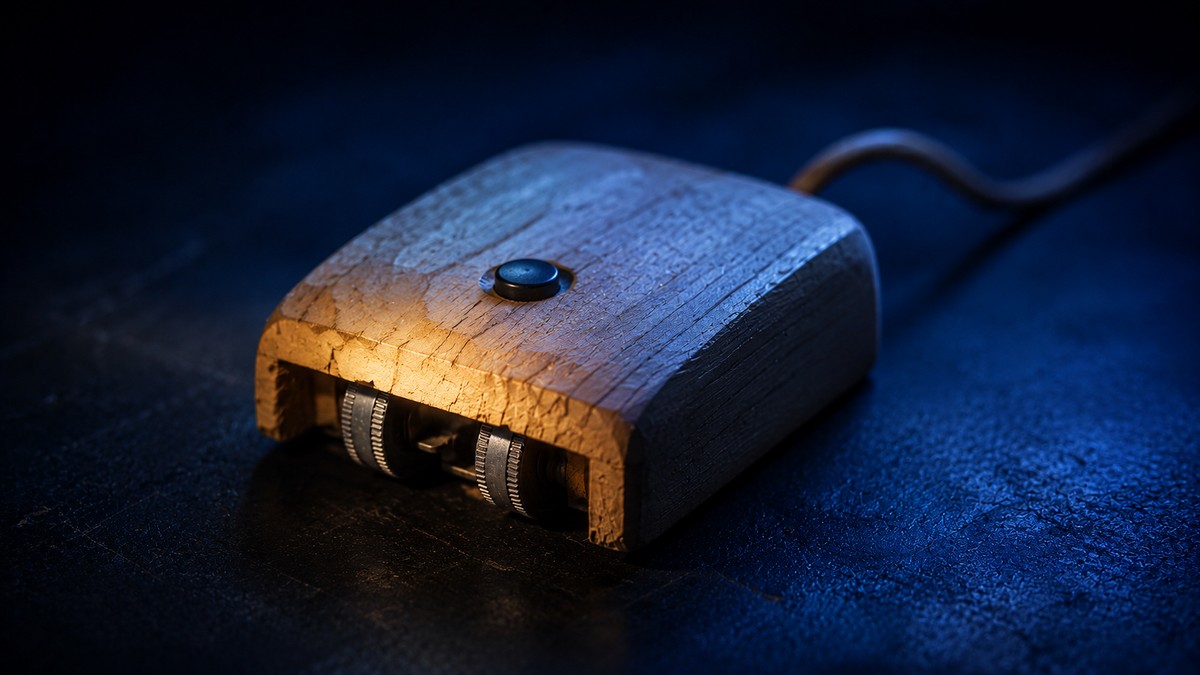
The first mouse was not slick. It was a small block of pine wood, hand-carved into a chunky little box. Underneath sat two metal wheels, one for tracking horizontal movement and one for vertical, and on top there was a single button. That was the whole device. No scroll wheel, no laser, no extra buttons, just a wooden box you scooted across a desk to move a dot on a screen.
Out the back of that box poked one wire. It trailed across the desk behind the device as you pushed it around. If you watched it move from across the room, you saw a small chunky body scooting along with a long thin cord dragging behind it. People in the lab looked at that and saw a mouse with a tail. The nickname showed up almost immediately, and it had nothing to do with branding or design intent. It was just what the thing looked like.
The name was never official
Here is the part that surprises most people. Nobody at the lab declared that this device would be called a mouse. There was no announcement and no committee that voted on it. The casual name simply won because it was easy. You could not ask a coworker to hand you a formal X-Y position indicator without feeling ridiculous. You could ask them to pass the mouse.
The word was short, it described what you saw, and it required zero explanation. So the joke stuck, it spread from desk to desk, and by the time the device reached the rest of the world the stiffer technical phrasing had quietly disappeared. The accident became the standard. The name was never official, it just stuck, and sixty years later it is still here.
What naming in tech really looks like
It is tempting to think the words and tools we use every day arrived through careful planning. Most of the time they did not. The names that last are usually the ones that feel obvious the moment you hear them. They do not need a glossary. They map directly onto something you can already picture, which is exactly why a wooden box with a cord could become a mouse and stay a mouse.
That pattern shows up all over technology. The desktop, folders, and trash can on your screen all borrow from the physical office because those pictures need no instructions. When a name or an interface feels obvious, it sticks. When it feels like a manual, it gets replaced. The mouse is the cleanest example of a casual, accurate description beating a precise, forgettable one.
Why obvious wins in product design
This is more than trivia for anyone building software today. The same instinct that made a tail-shaped cord into a mouse is the instinct good product design chases on purpose. You want people to understand what something does before anyone explains it. You want the name, the button, and the screen to feel inevitable, like they could not have been anything else. When you reach that point, you stop needing tutorials, and people just use the thing.
That is the bar we hold ourselves to when we build something for a client. The most polished feature in the world fails if a user has to stop and decode it, while the simplest idea wins when it feels familiar on the first try. If you are working on an app or a tool and want that kind of clarity baked in from the start, that is exactly the work we do in custom app development. The goal is never to be clever. The goal is to be obvious, the way a chunky wooden box with a cord was obviously a mouse.
So the next time you reach for yours, remember it is named after a joke that nobody made official. A pine block, two metal wheels, one button, and a cord that trailed like a tail. The engineers solved a hard problem, and the name solved itself. That is usually how the good ones happen.
Prefer to watch?
Built by Buit builds practical apps and AI tools for businesses across South Florida. See what we make, or start a project.
Leave a Reply