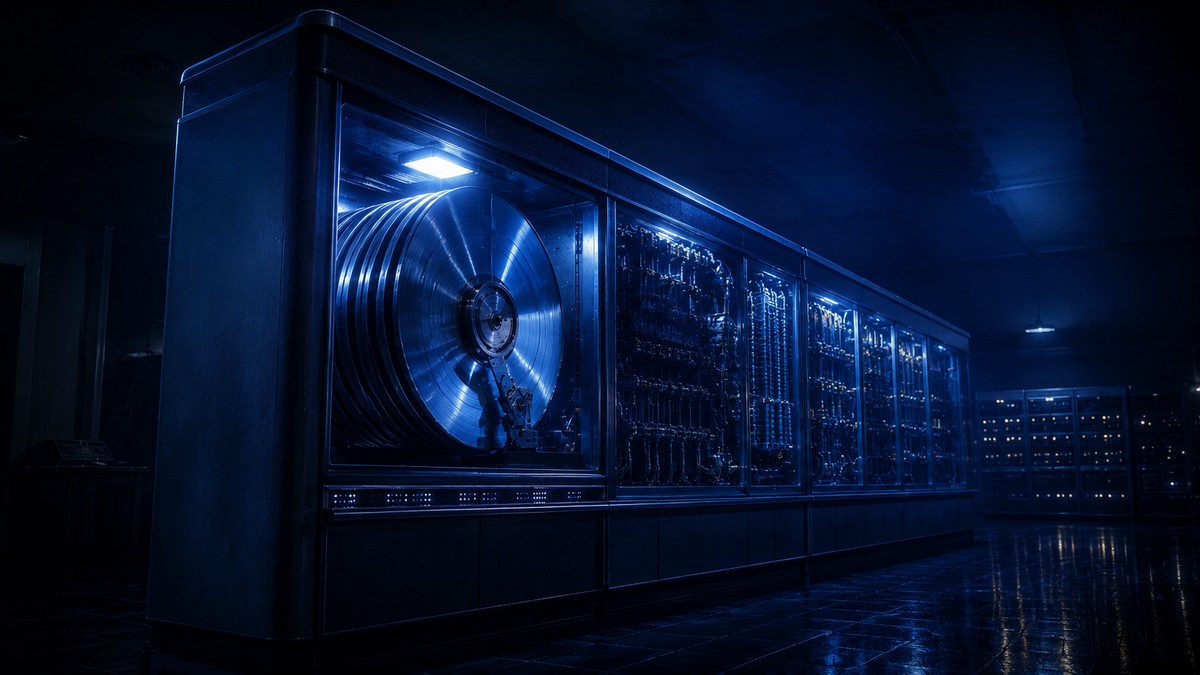
Take a guess. How much do you think the world’s first hard drive weighed? A few pounds? The heft of an old desktop tower? Something you could lift with one hand and carry across the room?
Try close to a ton. The first hard drive was a machine you moved with a forklift and shipped on a cargo plane, and the amount of data it held would make your phone laugh. It is one of the best snapshots of just how far storage has come.
Two refrigerators and a ton of steel
In 1956, IBM unveiled the RAMAC, and it was an absolute beast. It was the size of two refrigerators standing side by side, a genuine piece of furniture rather than a component you tucked into a case.
Inside, it had fifty spinning platters, each one two feet wide. Picture fifty of those enormous discs whirring away together inside a steel cabinet. All told, the thing weighed close to a ton. This was not a device you unboxed on a desk. Companies delivered these machines by cargo plane and moved them around with forklifts, the way you would handle industrial equipment.
That is the physical reality of early data storage. Not a sleek little box, but a room-dominating machine that took serious muscle and machinery just to put in place. Storing information used to be a heavy industrial affair.
All that machinery, five megabytes
So here is the payoff for all that steel and spinning glass. That entire machine, the two-refrigerator, fifty-platter, near-a-ton monster, stored about five megabytes. Five.
To put that in the plainest possible terms, that is roughly one photo from the phone in your pocket right now. Everything the RAMAC could hold, its whole capacity, would be used up by a single decent snapshot today. One picture. That is it.
The wild part is that back then, five million characters was considered an enormous amount of data. It was genuinely impressive, a huge leap forward for what businesses could store and access. Nobody in 1956 was disappointed by five megabytes. They were amazed by it. The bar for enormous has moved almost beyond comprehension.
From a ton to a fingernail
Now hold that image next to today. A microSD card, smaller than your fingernail, holds hundreds of thousands of times more data than the RAMAC did. And it weighs less than a paperclip.
Sit with the scale of that for a second. We went from a near-ton machine that needed a forklift to a chip you could lose in the crease of your palm, and the tiny chip wins by a factor of hundreds of thousands. The forklift lost to the fingernail, and it was not even close.
That is not gradual improvement. That is one of the most dramatic reversals in the entire history of technology. The thing that used to require a cargo plane now rides comfortably in a slot on the edge of your phone, doing vastly more.
The history behind the tech we build on
At Built by Buit, this is one of our favorite reminders of just how much foundation sits under the software we make. Every app you use casually assumes storage that is cheap, tiny, and effectively unlimited, a luxury the RAMAC’s owners could never have dreamed of. All that progress is quietly holding up whatever you build on top of it. When we take on custom app development, we get to stand on seventy years of that momentum.
So the next time you drag a file into a folder without thinking, remember the RAMAC. Two refrigerators, fifty platters, close to a ton, moved by forklift, holding about as much as one photo. We went from that to a fingernail-sized chip in less than a lifetime. That is the ground the entire digital world is built on.
Prefer to watch?
Built by Buit builds practical apps and AI tools for businesses across South Florida. See what we make, or start a project.
Leave a Reply