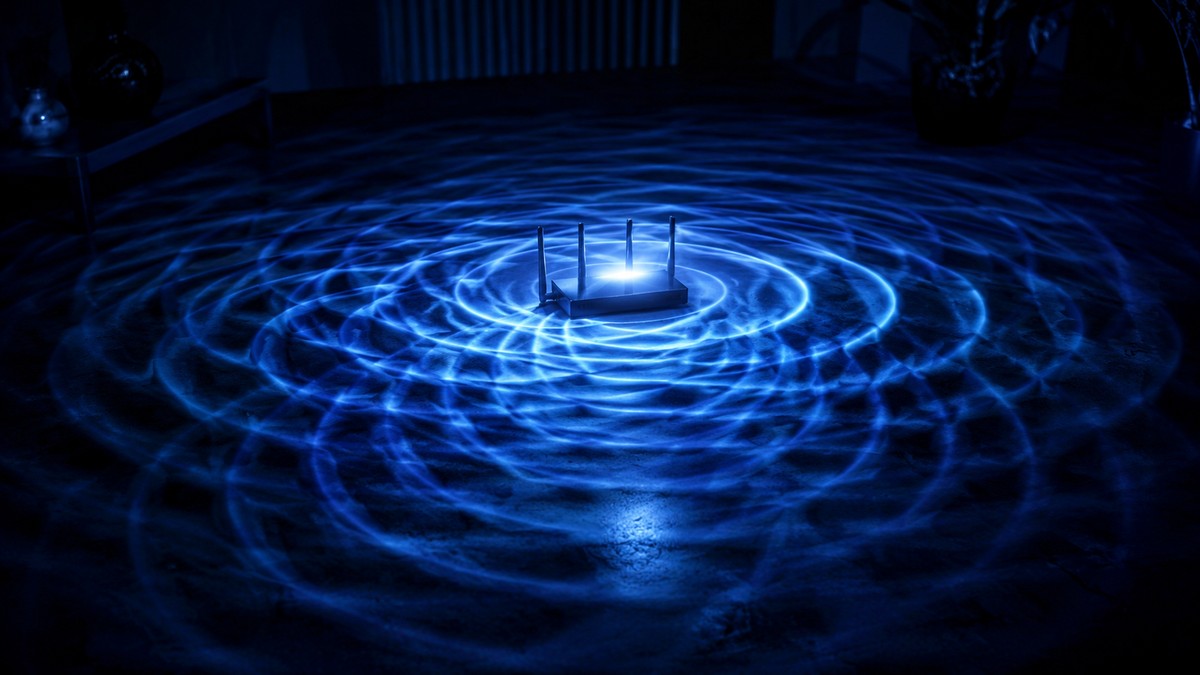
The next time your video call stutters the exact second someone starts the microwave, you are not imagining it. Those two machines are quietly at war, and they are fighting over the same tiny slice of the radio spectrum. That squabble in your hallway is just the surface of one of the stranger origin stories in modern tech, a story stitched together from a failed physics experiment, a 1940s movie star, a junk frequency nobody wanted, and a name that means absolutely nothing.
We build software for a living, so we have a soft spot for the boring-but-true engineering story behind the things people take for granted. WiFi is one of the best examples we know. Here is how four unrelated accidents collided inside that little box blinking on your shelf.
Your microwave got to the frequency first
Start with the war between your router and your kitchen. WiFi and your microwave oven both operate at 2.4 gigahertz, and that is not a coincidence. The microwave got there first. Ovens have been blasting away at 2.4 gigahertz since the 1940s, and they polluted that slice of the spectrum so badly that regulators eventually wrote it off. It was too noisy for any serious licensed use, so they labeled it junk.
Then, in the 1980s, the FCC threw that junk band open. Free, unlicensed, for anyone who wanted it. And that is the door WiFi walked through. WiFi, Bluetooth, and your wireless mouse all moved into the cheap, trashed neighborhood nobody else wanted, the one your microwave had already wrecked decades earlier. So every time your call stutters while someone makes popcorn, you are hearing two devices argue over territory a kitchen appliance claimed eighty years ago. That is accident number one: WiFi lives at 2.4 gigahertz because it was the only free real estate around.
A failed hunt for black holes built the brains
Getting a free frequency is one thing. Making a clean signal actually work indoors is much harder, and that fix came from an even stranger place. Back in the 1970s, an Australian radio astronomer named John O’Sullivan was trying to detect tiny exploding black holes, the faint radio bursts they were predicted to give off. The trouble was that those signals arrived smeared and tangled, echoing on their way to the telescope.
So O’Sullivan built a clever bit of math to un-smear them, to pull a clean signal out of all that noise. He never found the black holes. The experiment failed. But years later, engineers realized that the exact problem he had solved, signals bouncing and echoing off surfaces, is precisely what wrecks wireless data as it ricochets around the walls of a room. His failed-experiment math became a core piece of how WiFi works. His lab, CSIRO, patented it, and that patent ended up inside billions of devices. A dead-end space experiment quietly became the engine of your home network.
The movie star and the torpedo patent
There is a third thread, and it is the one people love most, so it is worth telling carefully. The widely told story goes like this. One of the biggest movie stars of the 1940s, Hedy Lamarr, was famous on screen and a self-taught inventor off it. During World War Two, she and composer George Antheil designed a system meant to keep radio-controlled torpedoes from being jammed by rapidly hopping the signal across many frequencies. They patented the idea in 1942. The Navy ignored it at the time.
That idea, called frequency hopping, went on to become a conceptual foundation of modern wireless. The same basic notion of spreading a signal across the spectrum instead of parking it on one channel lives inside the technology in your pocket today. It is fair to call Lamarr’s patent an ancestor of the spread-spectrum thinking behind WiFi, Bluetooth, and GPS, as long as you remember it is a lineage of ideas, not a straight line where an actress personally wired up your router. A Hollywood star helped plant a seed. That is the honest version, and it is still a great story.
And the name means nothing at all
After all that genuine ingenuity, here is the twist that undoes people. WiFi does not stand for anything. If you have heard it means “wireless fidelity,” someone invented that later. According to a founding member of the WiFi Alliance, the name was never short for anything at all.
Back in 1999, a branding firm called Interbrand was hired to come up with something catchier than the actual technical name, which was the painfully boring IEEE 802.11b. They landed on WiFi, a play on Hi-Fi, the old term for high-quality home audio. The phrase “wireless fidelity” got bolted on afterward by board members who wanted the name to mean something. It did not. They eventually dropped the phrase because it kept confusing everyone. So the name on the network powering your entire house is pure marketing. A good name, but an empty one.
Why the boring version is the good version
Put it all together and WiFi is a beautiful accident. A frequency nobody wanted, salvaged math from a failed black hole hunt, a wartime idea from a movie star, and a made-up name. Four things that had nothing to do with each other, colliding inside a device you never think about.
This is the kind of history we chase when we build things. The stuff people take for granted almost always has a messier, more accidental story underneath than the marketing lets on. Understanding that real story is how you build software that holds up. If you want to see how we turn practical problems into working software, that curiosity about how things really work is where all of it starts.
Prefer to watch?
Built by Buit builds practical apps and AI tools for businesses across South Florida. See what we make, or start a project.
Leave a Reply